Medical Disclaimer: The content on this site is for informational and educational purposes only and is not a substitute for professional veterinary advice, diagnosis, or treatment. Pet Decoder AI analyzes audio and behavioral patterns to provide data-driven insights but cannot diagnose medical conditions. Always seek the advice of your veterinarian with any questions you may have regarding a medical condition.
It is a sound every dog owner knows intimately. Your dog walks into the room, circles three times on the rug, and collapses with a heavy, dramatic harrumph. Or perhaps they are already asleep, and a low, guttural grunt escapes them every time they shift position.
As a pet parent, your brain often jumps to the worst-case scenario. Is he hurting? Is that a sign of arthritis? Or is he just enjoying the best nap of his life?
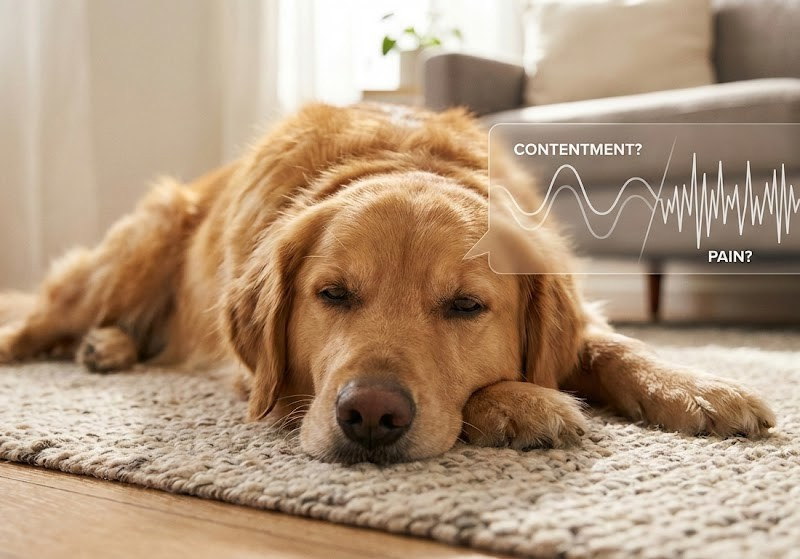
The truth is, interpreting dog sounds isn't always straightforward. A grunt can be the canine equivalent of a human sigh of relief after a long day, or it can be a subtle indicator of stiffness or distress. The difference often lies not just in the sound itself, but in the context and micro-expressions that accompany it.
In this guide, we will break down the nuances of why dogs grunt when lying down, helping you distinguish between a state of pure contentment and a potential request for help.
The Mechanics: What Actually is a Grunt?
Before analyzing the emotion, it helps to understand the biology. Biologically, a grunt (or a groan) occurs when air is forced out of the lungs through the vocal cords while the diaphragm contracts.
When a dog "flops" down to sleep, the physical impact of their body weight settling against the floor often pushes air out of the lungs involuntarily. This mechanical grunt is typically normal and purely physiological. However, when the vocalization is voluntary—meaning the dog controls the sound—it is a form of communication.
To understand what is being communicated, we must look at the "Whole Dog" picture: the ears, the eyes, and the body tension.
Scenario A: The "Happy Grunt" (Signs of Contentment)

In the vast majority of cases, particularly with puppies and young adult dogs, grunting is a sign of relaxation. It signals that the parasympathetic nervous system (the "rest and digest" mode) is taking over. Think of it like a human sinking into a hot bath and letting out a long "Ahhh."
You can usually identify a "Contentment Grunt" by looking for these accompanying "Green Flags":
1. The "Puppy Pile" Effect
If your dog grunts immediately upon settling into their bed, a sunbeam, or your lap, it is usually a sign of comfort. The sound is often low-pitched, long, and ends with a deep exhalation. Crucially, it is usually a single event—they grunt once upon impact, and then silence follows.
2. "Soft" Body Language
Look at their face. Are the eyes half-closed or blinking slowly? Are the ears relaxed or flopped to the side (not pinned back)? Is the mouth slightly open? If the body appears loose and "fluid" rather than stiff, that grunt is likely an expression of joy or relief.
3. The Context Clues
Did you just finish a long walk? Did they just eat a big meal? A grunt in these situations is simply the body powering down. This is often referred to in animal behavior as the "involution of pleasure"—a state where the animal feels safe enough to let its guard down completely.
Scenario B: The "Discomfort Grunt" (When to Pay Attention)
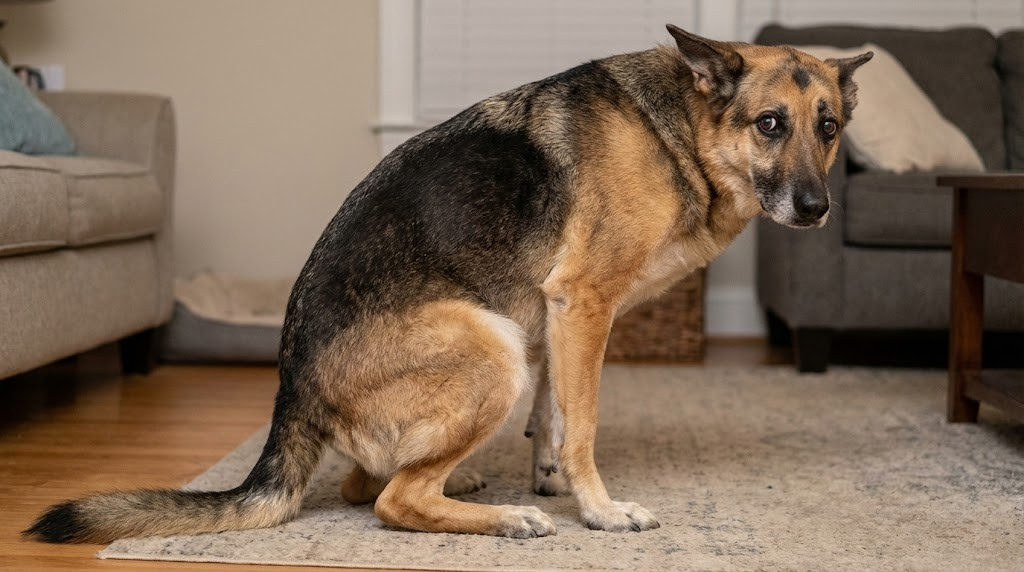
Dogs are evolutionarily wired to mask pain to avoid appearing weak to predators or competitors. By the time a dog is whining or limping, the discomfort is often significant. However, subtle grunts can sometimes serve as early indicators of chronic issues, such as osteoarthritis or hip dysplasia, especially in senior dogs.
Here is how to differentiate a potential "Pain Grunt" from a happy one:
1. The "Prep" Work
Watch how your dog lies down. A dog experiencing joint stiffness often circles excessively, seemingly unable to get comfortable. They might hesitate before dropping their hips or lower themselves very slowly, inch by inch, rather than flopping. If a grunt accompanies this slow, careful movement, it is consistent with the exertion required to lower a sore body.
2. Rhythmic Grunting
If your dog has already been lying down for 20 minutes and grunts while shifting weight, take note.
Joint Discomfort: Shifting positions puts pressure on elbows or hips.
Internal Discomfort: If the grunt is sharp, short, or rhythmic (occurring with every breath), and is accompanied by a rigid stomach or "prayer position" (front legs down, rear end up), this requires immediate veterinary attention as it can signal abdominal distress (such as bloat or pancreatitis).
3. "Hard" Body Language
Unlike the relaxed "Happy Grunt," a dog in distress will often hold tension in their face. Look for:
"Whale Eye": Seeing the whites of their eyes (sclera) while they look at you without moving their head.
Pinned Ears: Ears held tightly back against the skull.
Isolation: Going to a different room to sleep, away from the family, which is a common instinct for animals feeling unwell.
(Note: For more on identifying signs of pain, we recommend reviewing resources from the American Animal Hospital Association (AAHA).)
Breed-Specific Sounds: The "Snort" Factor
If you own a brachycephalic breed—such as a Pug, French Bulldog, or English Bulldog—the baseline for "normal" sound is different.
These dogs have anatomical differences, including elongated soft palates and shortened airways. For them, grunting, snorting, and snoring are often constant background noises. However, owners should remain vigilant. If the grunting becomes louder, more frequent, or sounds "wet," it could indicate respiratory issues like Stenotic Nares (tight nostrils).
If a flat-faced dog grunts while lying down and also has blue-tinged gums or appears to be struggling for air, this is a medical emergency, not a breed quirk.
The 3-Step "Check" for Concerned Owners
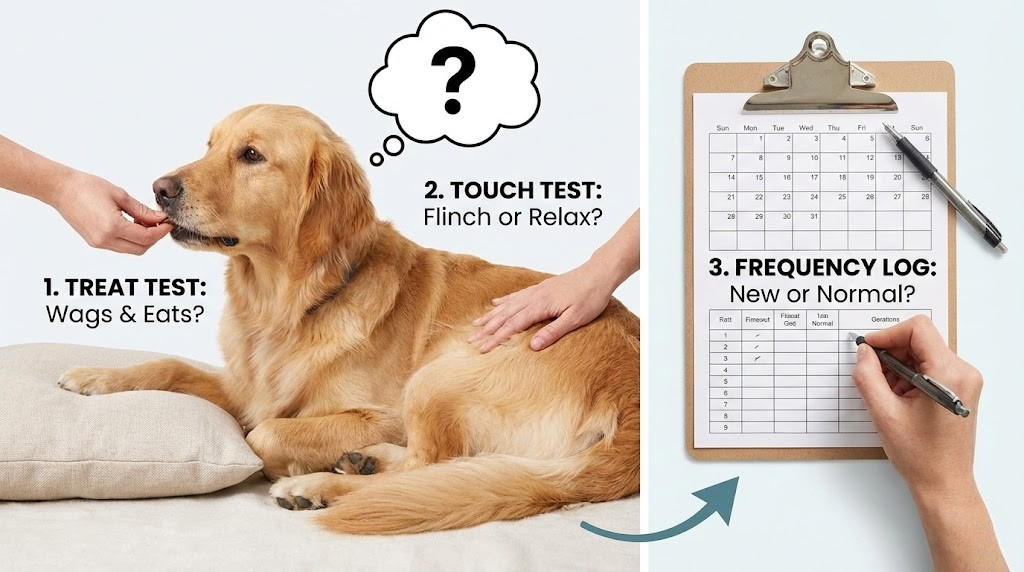
If you are reading this article, you are likely looking for validation. Is it pain? Is it joy? Try this non-invasive three-step check the next time your dog grunts to gather more data.
1. The "Treat Test" When they grunt, quietly offer a high-value treat. A relaxed, happy dog will usually wake up, wag, and take it. A dog in pain or significant distress may ignore the treat, or may growl if you force them to move to get it.
2. The "Touch Test" Gently run your hands over your dog's hips, spine, and stomach. Do they flinch? Do they grunt again when you touch a specific spot? Do they turn to nip at your hand? Sensitivity to touch is a clear indicator of localized pain.
3. The Frequency Log Is this behavior new? If your 2-year-old dog has always grunted, it’s likely just their vocal personality. If your 8-year-old dog suddenly started grunting this week, that is a change in behavior that warrants a discussion with your vet.
When to See a Veterinarian
While most grunts are benign, you should book an appointment if you notice:
Difficulty standing up or lying down.
Changes in appetite or lethargy.
Grunting accompanied by vomiting or diarrhea.
A "roached" back (hunched spine) while standing or walking.
Persistent panting when the house is cool.
Trust Your Gut (And Your Data)

You know your dog better than anyone. If a sound feels "off" to you, it is worth investigating. While dogs can't speak human language to tell us "my hip hurts" or "I'm just so comfy," they give us thousands of audio and visual clues every day.
The difference between a happy sigh and a painful groan can be subtle, often coming down to a slightly different pitch or a millisecond of hesitation.
Still not sure what your dog is saying? Don't rely on guesswork. Visit Pet Decoder AI to use our advanced audio analysis tool. Simply record a video of your dog with the vocalizations, and let our AI do the rest. While our tool provides data on emotional states, it is designed to work alongside your intuition and your veterinarian's expertise to give your pet the best care possible.
Unsure what your dog's grunts mean? Record a short clip and try our video symptom checker to review posture and breathing cues before talking with your vet.