Medical Disclaimer: The content on this site is for informational and educational purposes only and is not a substitute for professional veterinary advice. Pet Decoder AI analyzes audio and behavioral patterns but cannot diagnose medical conditions. If your cat is straining to urinate, vocalizing while in the box, or unable to pass waste, this is a potential medical emergency—please consult a veterinarian immediately.
It’s a scenario that leaves many cat owners baffled.
Your cat walks calmly into the litter box. You hear the familiar scratching of sand. Then, suddenly, chaos ensues. Your cat bolts out of the box as if they were shot from a cannon, sprinting down the hallway, eyes dilated, letting out a loud, melodic howl or yowl.
You are left standing there wondering: Did something bite him? Is he scared? Or is this just a weird cat thing?
This phenomenon is incredibly common, but the difference between a "victory lap" and a cry for help can be subtle. In the feline world, the litter box is a health report card. The sounds they make around it—before, during, or after—tell a story about their internal health.
In this guide, we will help you decode the "Post-Poop Howl" and determine if you are witnessing a moment of pure euphoria or a sign of a medical blockage.
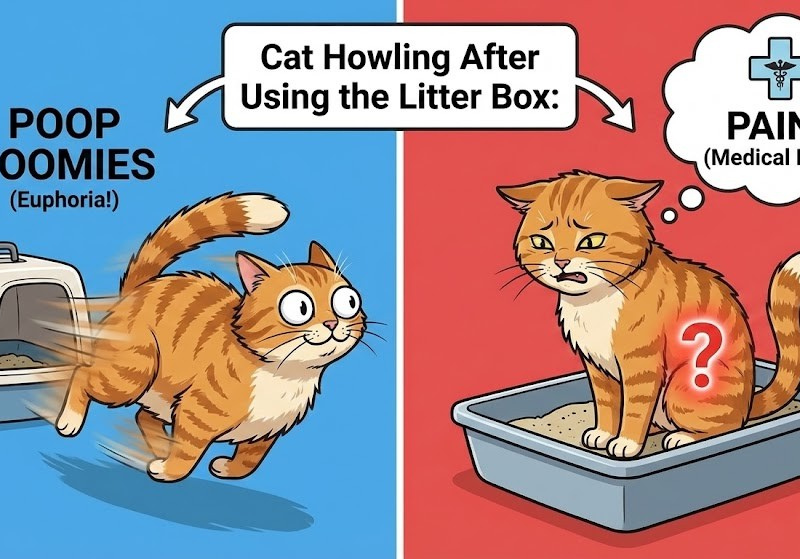
Scenario A: The "Poop Zoomies" (Why It’s Usually Normal)
If your cat howls and sprints after successfully doing their business, congratulations: you are likely witnessing "Defecation Euphoria."
While it sounds like a made-up term, there is real biology behind it.
The Vagus Nerve Connection
The vagus nerve is a massive nerve that runs from the brain stem down through the neck and into the colon. When a cat passes a large stool, the distension of the rectum stimulates this nerve.
For some cats, this stimulation triggers a sensation that is described as "pleasurable high" or a sudden drop in heart rate followed by a rebound. This creates a massive, sudden release of energy.
The Signs of a "Victory Lap":
The Timing: The howling happens immediately after they leave the box.
The Sound: It is often a loud, rising-falling yowl (caterwauling) that sounds almost triumphant.
The Action: They run. Fast. They might scratch the carpet aggressively or climb a cat tree in seconds. This is the classic "Zoomies."
The Result: If you check the box, there is a normal-sized, healthy stool.
In this scenario, the howling is just an announcement: "I feel lighter, and I am fast!"
Scenario B: The "Pain Cry" (When to Worry)
Unfortunately, the litter box is also the most common place for cats to express pain. Cats are stoic; they hide illness well. But when they are trapped in a box trying to perform a bodily function that hurts, their mask often slips.
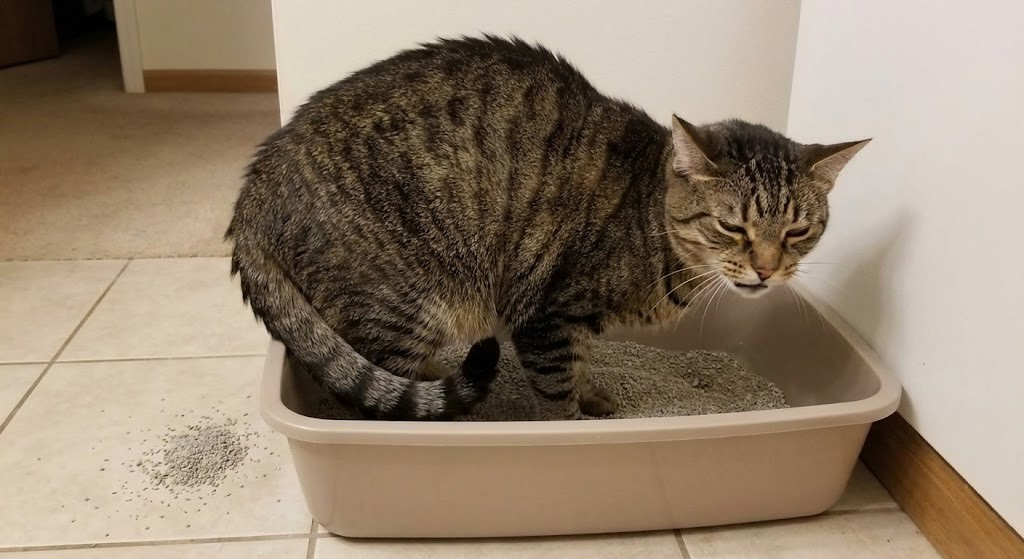
If the howling happens before or during the act, or if the "sprint" seems frantic rather than playful, you need to investigate.
1. Urethral Obstruction (The Silent Emergency)
This is the most critical condition to rule out, especially in male cats. If crystals or mucus block the urethra, the cat cannot pee. This is a veterinary emergency if untreated for 24 hours.
The Sound: A low, guttural growl or a sharp, strained "pip" sound while they are squatting.
The "False" Sprint: They may jump out of the box and howl, then run away. They are not running from joy; they are running from the pain, associating the litter box with the hurting sensation.
The Tell: They go back. If your cat sprints out, howls, but then goes back to the box 5 minutes later to try again, this is a blockage.
2. Constipation and Megacolon
If the stool is too hard/dry, the act of pushing is physically painful.
The Sound: Strained grunting or crying.
The Result: You check the box and see small, hard "pebbles" or nothing at all.
3. Feline Idiopathic Cystitis (FIC)
Stress can cause the bladder wall to become inflamed. Even if there is no blockage, urinating hurts. These cats often howl at the litter box before entering, staring at it like it’s an enemy.
Scenario C: The Senior Factor (Arthritis)
If your cat is older (10+ years) and has started howling near the litter box, the issue might not be internal—it might be structural.
Most litter boxes have high sides. For a senior cat with osteoarthritis in the hips or spine, stepping over that 4-inch rim is painful. Furthermore, the "squatting" position requires significant hip flexibility.
The Clue: They howl before entering, seemingly hesitating. Or, they might eliminate right next to the box because the urge to go was there, but the pain of entering was too high.
The Fix: Switch to a "low-entry" litter box or a plastic storage bin with a door cut out of the side.
Visual Guide: Is He Straining or Just Focused?
Distinguishing between a cat who is "focused" and a cat who is "straining" is vital.
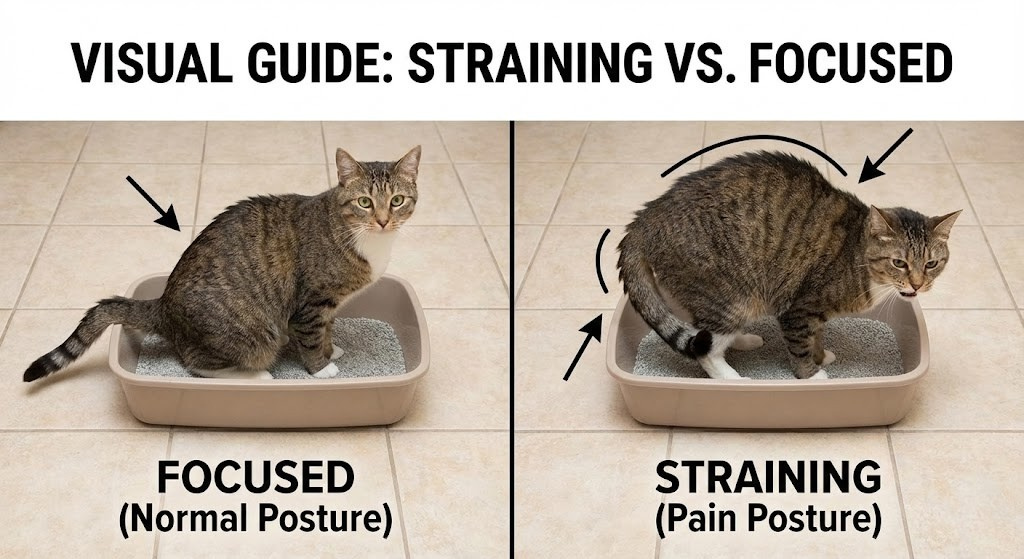
Normal Posture:
- Back is relatively flat or slightly curved.
- Tail is relaxed or slightly raised.
- Rear end is lowered comfortably.
- Face is neutral.
Straining (Pain) Posture:
- Back is arched high (hunched).
- Tail is twitching or held tight against the body.
- Rear end is raised; they seem to be "standing on tiptoes."
- Face is tense; whiskers are pulled back.
The 3-Step "Litter Box Check" Protocol
If you hear the howl, don't ignore it. Perform this 30-second check to decide if you need a vet or just a feather wand.
1. The "Output" Check
Go look in the box immediately.
Is there a clump? If yes, and it’s normal size, you are likely safe (Zoomies).
Is it empty? If they were in there for 2 minutes, screamed, and left nothing, this is an emergency.
Is there blood? Even a drop of pink means a vet visit is needed today.
2. The "Touch" Test
After the sprint, when they settle down, gently touch their stomach (abdomen).
Reaction: A healthy cat might bunny-kick you playfully. A blocked or constipated cat will often growl, hiss, or tense up because their bladder/colon is hard and painful.
3. The Audio Analysis
Was the sound a "Yowl" (long, melodic) or a "Cry" (short, sharp, or grunting)?
Yowl: Usually behavioral/hormonal/energy.
Cry/Grunt: Usually pain.
How to Be Sure (Use Tech, Not Guesswork)
It can be stressful to guess. Is he blocked? Or just crazy?
If you are unsure about the vocalization your cat is making, capture it.
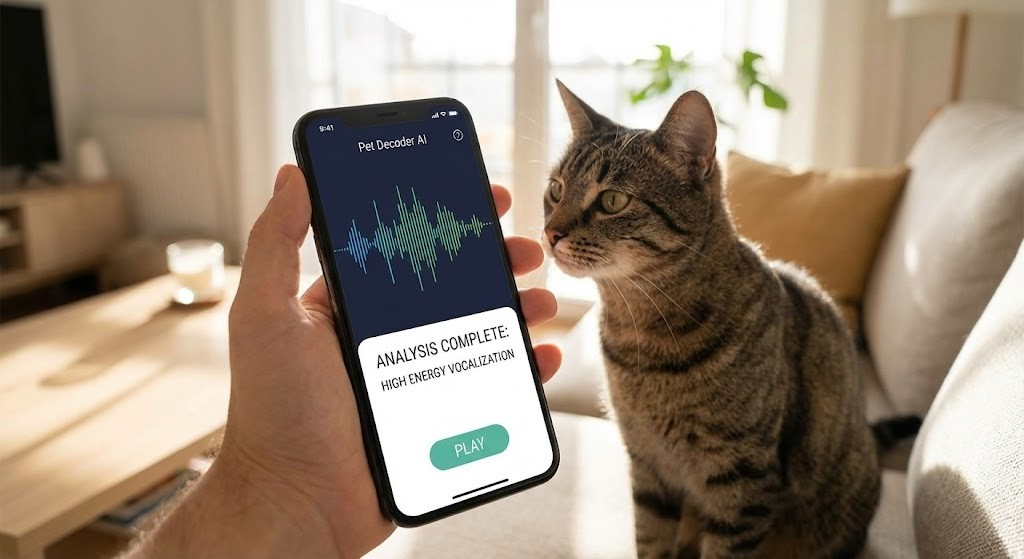
Visit Pet Decoder AI and use our audio analysis tool. You can record the sound your cat makes after using the box. Our AI will analyze the audio and give suggestions and provide insight into what the issue could be.
While technology never replaces a vet exam, seeing that the sound wave matches a "Distress" pattern can give you the confidence to pack up the carrier and go to the ER, rather than waiting until morning.